






Opening Times
- Mon - Sat
- 9.00am - 5.30pm
- Sundays
- Closed






Current Model

Roland E80
This instrument is discontinued
Other Options
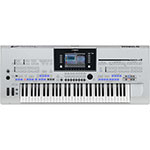
£1299.00
Yamaha Tyros 4 Keyboard - Used--Available Now--
£1014
Korg PA900 Keyboard Secondhand--Available Now--
£2198.99
Korg PA4X-76 Pre Owned--Available Now--
£2499.00
Korg PA4X-76 Bundle with PAAS Pre Owned--Available Now--
£2299.01
Yamaha Genos Keyboard Second Hand--Available Now--
£1699.01
Korg Pa1000--Available Now--
£1049.01
Korg Pa700 Keyboard--Available Now--
£2599.01
Yamaha Pre-Owned Genos with New GNS-MS01--Available Now--
| info |
|---|
The best keyboard Roland have ever made !
| With a keyboard of this power the first concern of any user is how to get to grips with it, how easy is it to use ? Video recorders became popular in the .80s, everyone had one in the 90s and with the dawn of the new millenium they were superceeded by the DVD. In all that time how many people actually figured out how to use the timer to record their favourite show...I didnt. The Roland E80 is intuitive, buttons are grouped together by function, with plenty of space between each group, its very easy on the eye with no clutter. Choose a rhythm, press the one touch play and away you go. It sounds great straight out of the box and this encourages you to explore. When you do explore its obvious where you are, pages lead logically to the next page and so on. There is lots to learn though, this keyboard has many features that you havent seen on other keyboards, and all the features you would expect from Rolands top of the range E80. | |
 |
|
| Review by Janet Dowsett THE LOOKSMy first impression of the Roland E80 is that it is very stylish to look at, compact and easy to carry while looking modern and elegant at the same time. The colouring is two-tone, mainly light silver, but with charcoal panelling and speaker grills. I liked the raised front operation panel: it really is visually striking, and I was interested to discover that the casing was designed by a professional design company in Italy, exclusively for Roland. There are 61 standard keys (not the longer keys which you find on the G range), which feel nice to play. This size keyboard is a nice fit for most peoples homes. |
THE SPEAKERSThe speakers are built in to the Roland E80. This is where I came across the first new feature, speaker modelling. You can electronically change the type of speakers. This is easily done by pressing the effects button on the left of the screen, then pressing it again. Going to the edit button will take you straight to a choice of speakers. If you select Super Flat the sound of the speakers change. Perhaps you will choose Small TV or Powered Speakers and so on. The screen shows you a pretty picture illustrating the type of speakers youve selected. All very cleveri In addition, you can decide to enhance the bass digitally - either off, low or high. You can also turn them off completely if you are playing at a gig and wish to use external speakers only. The speakers are known as a four speaker bi-amped sound system - Roland says they give a clear high definition sound which covers the whole range of frequencies on the Roland E80 keyboard. To be honest, I couldnt hear a huge difference between the types of speakers with the speaker modelling system, but then I was on a very busy stand at a festival, and this was a prototype instrument. |
THE STYLESA major feature of the Roland E80 is the fifty brand new styles. These have been created by a team of international specialists. Were all so used to listening to keyboard styles that I suppose we can get a bit blase and bored by them. Not these styles: I was really bowled over by the sound quality of them all, and particularly by how innovative but useable many of them are. So often on keyboards you can listen to a wonderful intro and ending but wonder what tune to play in-between. But with the new styles on the Roland E80 it is so very obvious theyve been based around particular songs that the intros are instantly recognisable. For instance, Breezy Swing must be used for Let There Be Love the ending even has all the correct chording for the songs and it really is terrific to listen to. I found it quite inspiring. Equally good is Baby Rock N - this instantly conjures up images of My Baby Just Cares For Me. I must tell you about Jimmys Groove style. This really got me going. It features the most amazing Hammond organ sound and you need to break into a rendition of The Cat in Jimmy Smith mode. A few minutes of playing this and I was being sent. However, I persuaded myself to move on and found many other really motivating new styles: Bennys Big Band brought Benny Goodman to life. Angel Ballad was absolutely spot-on for playing Robbie Williams Angels and Joes Rock had me wanting to play You Can Leave Your Hat On from The Full Monty. There are several up-to-date dance rhythms such as Ladies Dance, and Survive Disco this one turns you into Gloria Gaynor. Breaky Rock is great for line-dancing, and I must mention Downtown Funk which took me back to watching Starsky and Hutch on television. |
A UK specialist was responsible for a most outstanding new style called Irish. Its obviously based on The Lord Of The Dance, and immediately took me back to a trip to Dublin last year when I watched Irish dancers. Use this style with the wonderful Flute Vib Atk voice for a really fantastic sound. Its obvious that a great deal of thought has gone into the production of these styles. Neil Evans from Roland told me that a lot of research was done in the UK last year when customers and dealers were asked for their ideas about styles. The feedback was sent to head office and many of the fifty new ones have resulted from this. Although Ive told you about my particular favourites, all the styles sound very alive. This is due in some part to the fact that you can use up to three Master Effects on each one - things such as distorting the guitars, or adding sympathetic resonance to the piano parts. You can even individually EQ each part of a style, so making it very personal to you. Its also due to the use within the styles of some of the new voices on the E-80. |
THE VOICESThe Roland E80 has some new sounds. The most obvious is the new Natural Piano voice. This was sampled from the Roland RG7 electronic baby grand piano. Its a very high- quality piano sound indeed. There are also new guitars, such as the Clean El Oct, and the 12-string. Of most obvious use to me are the three new drum kits - New Brush Pop, New Pop and New Folk. These have lots of authentic percussion instrumental voices within the styles. They are especially good for Latin rhythms - for example the Orchestral Cha Cha style makes wonderful use of the new sounds. There are new cymbal rolls and crashes and drum diddles which I liked very much. You could use these live of course, played from the keys, in a drum solo, but they really do come into their own because of their inclusion in the styles. An interesting point while talking about the sounds: there are fewer of the more obscure voices you tend to find on keyboards these days. Ive listened to some sounds in the past and have been at a loss to know how would use them in my musical repertoire. To my mind its fairly pointless to have dozens of unnecessary sounds, which just fill up spec sheets. Im pleased to see that with the E-80 Roland has reduced the number of obscure voices to make room for better quality useable ones. |
|
THE SCREENThe touch screen is very easy to use and comprehensive. I want to tell you about a lovely feature, which I think has huge potential for the semi or pro player: There is now a Text and Image Viewer where you can store your own photo images on the screen. In fact, the E-80 is ab!e to import and show both (.TXT) and images files (.BMP) and by connecting to an external monitor it will display text, lyrics, photos and slideshows. So if you wish, you could look at yourself when you play, or your family photos! Just imagine what you could do with this if you attach an external link and show the pictures on a large screen. Maybe you could play at a wedding with images of the bride and groom on screen. Or flash up pictures of Frank Sinatra while playing My Way. The possibilities are endless. While talking about the screen, a nice new feature when in the Lyrics and Score area is a bouncing ball travelling across the music score when playing a MIDI file. You simply play a MIDI file and the notes appear for you on the screen. You can choose the options of one or two staves, with treble and/or bass clefs. You can also add the letter names to the notes if you wish. If you go to the lyrics page you can also have the chord symbols on display. Wouldnt it be nice if the chord symbols appeared on the score page as well? But you cant have everything. |
 Roland E80 Screen |
THE ATTENTION TO DETAILWhen I realised that Roland has added the bouncing ball to the score screen I began to notice other small details which have improved since the production of other models. These are only little things but it really shows that customer feedback is taken seriously. For instance, some customers had pointed out that the exit light on the right of the screen was irritating when it continued to flash. So you now have the option of turning this off, by going to the menu, then the utility/global settings/flashing exit. Nice! Also you now have direct buttons from the panel to access the guitar mode and the 16-track recorder, without having to go through a series of actions on the screen. The user program is now situated in the middle of the keyboard, for easy use. Just a reminder about the Guitar Mode: this was a totally new feature introduced on theRoland G70 Mark 2 Workstation. When you press the Arranger and Piano buttons together, a guitar mode screen appears (on the Roland E80 there is a direct button, as Ive just explained). This gives you a picture of a guitar, and a keyboard showing you different keyboard splits, with coloured notes to help. |
When you play a left-hand chord a fret diagram appears in the screen, showing you exactly what a guitarist would normally read. From Middle C to the next A, the notes now have different functions, and are not actually pitched as C, D, E, F, G and A notes. In fact, they have become the 6 strings of a guitar. You play a left-hand chord, and the right-hand notes will fit whatever chord you play, as if they really are guitar strings. When you change chord, youll hear fret noise. From the next C upwards, the keys have become a variety of strumming patterns, and other noises associated with guitar playing. One key makes the notes strum down, another makes them strum down and up, and so on. Ive never heard anything sound quite so real on a keyboard. To use this feature in live playing you will have to get your brain engaged (!), unless youre a guitarist anyway, in which case youll find it easy to use. Actually, I think the majority of people will use the Guitar Mode to add lifelike phrases into standard MIDI files, and into the Music styles. On reflection, Ive seen a different use of keys like this once before, on Hammond organs years ago when the bottom octave of keys on each keyboard used to be coloured black instead of white, and white instead of black. These keys didnt have any pitch, but were used to control registration changes on the corresponding keyboard. I always used to manage those control keys without difficulty, so I dont see why I couldnt use these guitar control keys efficiently with a bit of practice. |
THE SRX SLOTSRoland owners will probably be very familiar with the excellent SRX boards available, giving extra styles and voices. The SRX expansion board series offers a wide selection of the highest quality sounds, taken from the worlds top professional studios. The Roland E80 has not one but two slots for boards, which I think is a big improvement, and gives lots of scope for expanding the instrument on an individual basis. |
|
|
|
THE CONCLUSIONI enjoyed playing the Roland E80. I can see that it would appeal especially to the home player, due mainly to the compact look and feel. I personally like instruments with built-in speakers, for ease of use (several of my own students who carry their instruments back and forth to lessons with me, would also approve!). Pro and semi-pro players would also make very good use of the instrument, and might be glad not to have to carry around a cumbersome amount of equipment. Compared to the Roland G70s 76 keys, the 61-note keyboard can be viewed as an advantage or disadvantage, depending on how you play. For myself, I would rather have this smaller, sleeker, lighter instrument and lose a few keys in the process. In my opinion the new styles are super to listen to and inspiring to play to. Other basic features such as voices, drawbars, 16-track recorder, vocoder, etc are up to the standards weve all come to expect from Roland. |

Roland E80 Keyboard Specifications
| Specifications | ||
|---|---|---|
| Keyboard | 61-note synthesizer-action keyboard with aftertouch | |
| Sound source: | New WX sound engine | |
| Max. polyphony | 128 voices | |
| Sounds | 1100 tones,54 Drum Sets | Dedicated EQ for each oscillator (Keyboard/Style/Song parts) and for each drum instrument (Style/ Song) |
| SRX-series expansion (boards optional) | 2 slots | |
| Compatibility | SR-G01 compatible 32 GM2/GS/XG Lite | |
| Effects | Reverb:12 types | Chorus: 6 types |
| MFX: 84 types | ||
| multi-band compressor | ||
| Overdrive | ||
| Mastering Tools | parametric EQ,Harmonic Bar: Rotary, Vibrato,MFX: 84 types | |
| External audio input MIC input section | Noise Gate Compressor Reverb: 9 types Delay: 9 types | |
| Organ Drawbars | 9 harmonic bars (16, 5-1/3, 8, 4, 2-2/3, 2, 1-3/5, 1-1/3, Y) | Adjustable via assignable sliders |
| Organ Effects | Slow, Fast Leakage Level, Overdrive, Vibrato/Chorus (On, Off, V1,C1, V2,C2,V3,C3), Rotary Speaker Simulation (Slow/Fast, Motor on/off via MODULATION lever] | |
| Styles | More than 350 Styles in 12 families | 120 programmable links to additional Styles (CUSTOM] |
| Unlimited access Internal memory, memory card, floppy disk (via FINDER) | ||
| Style Cover | 18 Drum Covers | 24 Bass Covers |
| Instrument-oriented editing | ||
| One Touch | 4 programmable registrations per Style | |
| Songs: | Real-time SMF player | 4 programmable MARK & JUMP locations |
| Song Cover | 18 Drum Covers | 24 Bass Covers |
| Instrument-oriented editing | ||
| Song Makeup Tools | Lyrics & chord display, | score display, |
| VIEWER display (TXT and BMP), | DigiScore | |
| Other functions | PLAY LIST function (99 steps)NEXT SONG function | Text Import/Export & lyrics synchronization |
| Song Finder | Manages up to 99,999 songs Play & Search function | |
| Sequencer: | 16-track sequencer with microscope and macro editing functions, | Style Converter |
| Display type & controls | Color 1/4 VGA | Touch-screen with 3D-SG (3D simulated graphics) |
| Contrast potentiometer | ||
| Other Controls | PITCH BEND/MODULATION lever, D Beam controller (with macro settings), | |
| User Programs: | 144 Set List references for access via front pa nel | |
| Music Assistant registrations: | More than 650 factory registrations | Unlimited number of programmable entries |
| Vocal Harmonist: | 4 presets 2 Harmony modes Singer Key Adapter | Vocoder Effects Talk, Voice-FX (12 presets), Auto Pitch. Singer (programmable) Small (30 macros), Ensemble (30 macros) 24 presets |
| Noise Gate, Compressor, Reverb (9 types], Delay [9 types), programmable Reverb (9 types), Delay (9 types], Chorus (9 types), programmable Adjustable input gain, Level switch | ||
| Data storage | Floppy disk drive Internal memory Memory card | ,5\\\",2HD/2DD Solid-State Disk PCMCIA (Compact Flash, Memory Stick, Smart Media, Micro-drive) |
| Type of files managed | Styles, Songs (SMF), User Programs, MIDI Sets, Play Lists, .txt files, .bmp files | |
| Keyboard Modes | Split (2 split points), Whole, Dynamic Split | Arranger, Organ, Piano, Guitar Mode |
| Chord voicing Melody Intelligence | ACV (Adaptive Chord Voicing) 18 types, customization of the second sound | |
| Internal amplification | 2x 35W, 2x12W (with bass reflex system) | 2x 13 cm (woofer) 2x 6.6 cm (tweeter) |
| Dedicated SPEAKER OFF switch | ||
| Dimensions | 1176(W)x489(D)x 198 (H) | |
| Weight | 22.5kg | |
| Supplied accessories | Owners Manual, power cord, metal music stand. CD-ROM | |
| Options | PK-5A Dynamic MIDI Pedal, FC-7 Foot Controller, MSA/MSD/MSE series floppy disks (Roland & third-party), RH-25/50/200 Headphones, | DP-2 Pedal switch, DP-6 Pedal switch (piano type), BOSS FS 5U Foot switch, EV-5/7 Expression pedal, BOSS FV-300L Volume/Expression pedal, KC-150/350/550 Keyboard amplifiers Memory cards (third-party manufacturers) |
| Wave Expansion boards (SRX-series and SR-G01) | ||
| Connectors | Headphone sockets 2 Pedal & footswitch sockets FC-7 (programmable) FOOT PEDAL | HOLD FOOTSWITCH FOOT SWITCH (programmable) |
| Audio connections | Vocal Harmonist (with MIC/LINE switch] | Input: XLR&TRS phone (balanced/unbalanced |
| Audio inputs: | Left & Right, line level (with separate effects processor] (RCA/phono) | |
| Outputs | L/Mono, R (1/4\\\") Metronome OUTPUT (for headphones), LEVEL control Video output Composite, PAL & NTSC | |
| USB port | (data storage & MIDI communication] | |
| MIDI IN/OUT/THRU | ||
| Note: Specifications are subject to change without prior notice |